

Two jacket styles account for the majority of leather outerwear sales globally: the bomber and the biker. If you are building a wholesale leather jacket line, one or both of these silhouettes will almost certainly anchor your collection. The question every buyer asks us is which one sells better. The honest answer is that it depends on your market, but the data and our 25 years of production history point to clear patterns worth understanding before you commit capital.
This guide compares the bomber and biker jacket across every dimension that matters for wholesale: construction detail, manufacturing cost, target demographics, retail price positioning, and sell-through behaviour. We manufacture both styles daily at our facility in Karachi, and we will share what we see from the brands we supply across the UK, EU, North America, and the Middle East.
What defines a bomber jacket?
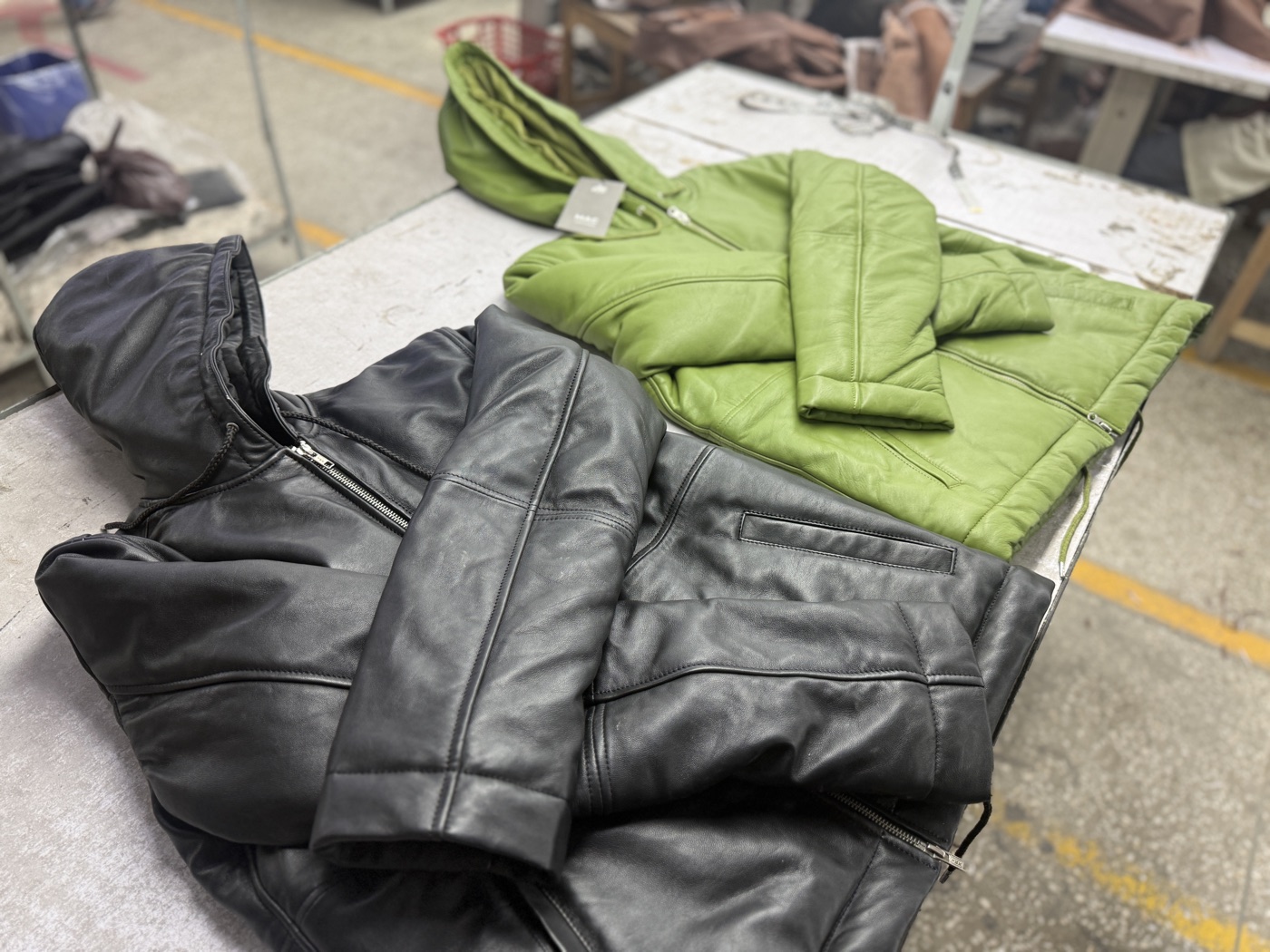
The bomber jacket descends from the A-2 flight jacket adopted by the US Army Air Corps in 1931. Military pilots needed warm, functional outerwear for unpressurised cockpits at altitude. The design that emerged has remained remarkably stable for nearly a century: a front zip closure running straight down the centre, ribbed knit cuffs and hem to seal out wind, a clean collar (either stand-up band or shirt-style), and a relaxed fit through the body.
Construction details
- Closure: Centre-front zip, typically a single YKK zip from hem to collar.
- Collar: Stand-up band collar, shirt collar, or occasionally a fur/shearling-trimmed collar on aviator variants.
- Cuffs and hem: Ribbed knit elastic bands. These define the bomber silhouette more than any other element. They create the characteristic blousing effect and snug fit at wrist and waist.
- Pockets: Two welt or flap pockets at the waist. Some designs include an internal pocket and a utility sleeve pocket (inherited from the MA-1 military specification).
- Hardware: Minimal. One zip, possibly two to four snaps. No belts, buckles, or epaulets.
- Pattern pieces: Typically 12 to 18 pieces. Relatively simple construction.
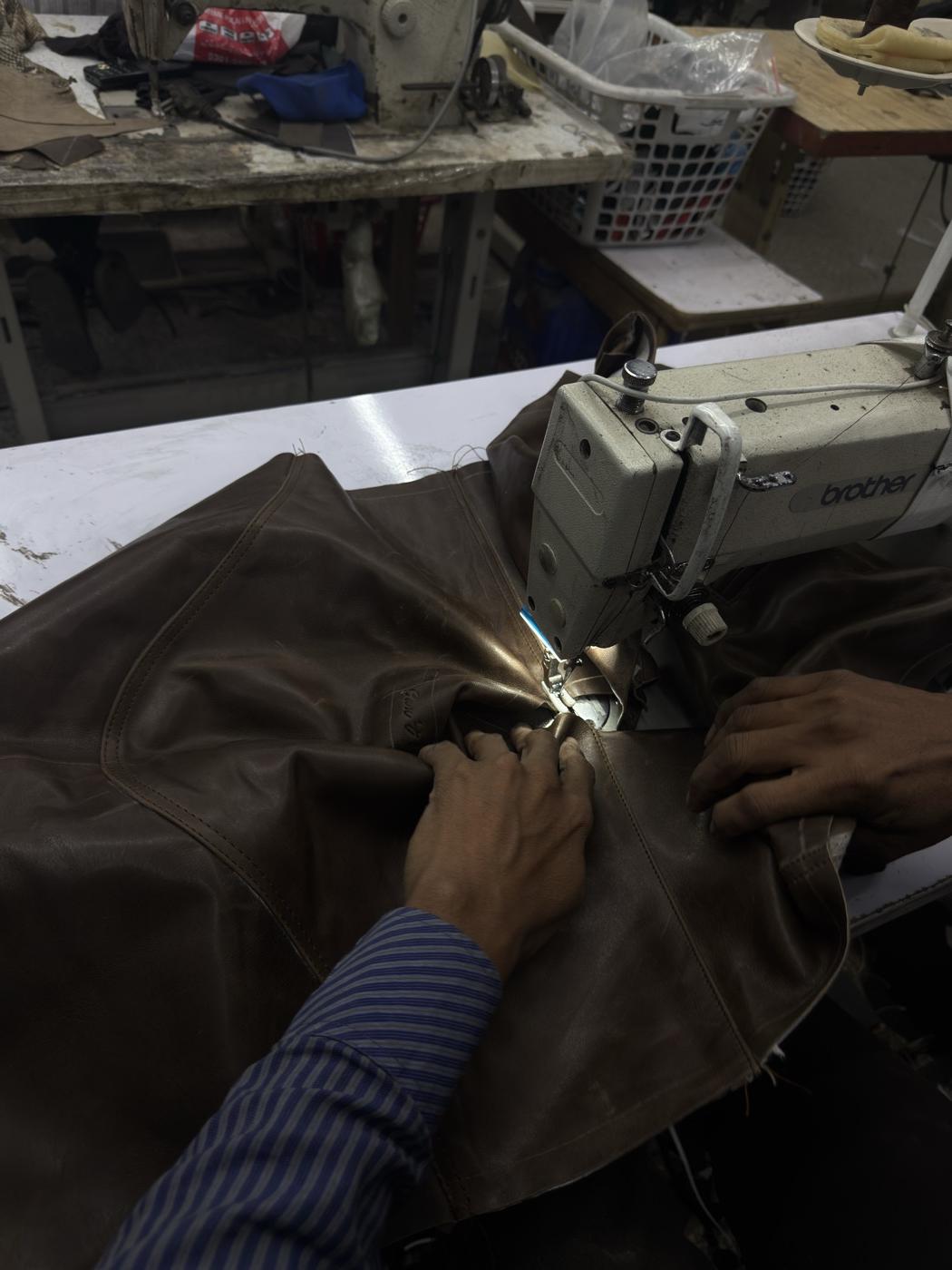
- Stitching time: 2.5 to 4 hours per jacket, depending on lining and pocket complexity.
The bomber’s defining characteristic is restraint. Clean lines, minimal hardware, and a silhouette that works across body types and styling contexts.
What defines a biker jacket?
The biker jacket was created in 1928 by Irving Schott of Schott NYC, designed specifically for motorcyclists. The original Perfecto model introduced the asymmetric zip, wide notched lapels with snap closures, a belted waist, and multiple zippered pockets. Marlon Brando made it iconic in “The Wild One” (1953), and the design has barely changed since because it did not need to.
Construction details
- Closure: Asymmetric (off-centre) zip. The zip runs diagonally from the left hip toward the right shoulder. This is the single most recognisable element of the biker jacket.
- Collar: Wide notched lapels with snap-down closures. The lapels can be worn folded down or snapped up to the throat for wind protection.
- Cuffs: Zippered cuffs, not ribbed. The zip allows the rider to pull gloves over or under the sleeve.
- Waist: Belted with a buckle, or half-belted with side adjusters. The belt creates the structured, nipped-waist silhouette.
- Pockets: Three to four zippered pockets (one chest, two waist, sometimes one internal). Some designs add a coin pocket or flap pocket.
- Hardware: Heavy. Five to eight zips, snaps on lapels and epaulets, D-rings, belt buckle, rivets at stress points. A biker jacket can carry 400 to 600 grams of hardware alone.
- Quilting: Many biker designs include quilted panels on the shoulders, elbows, or lower back. This adds visual detail and references motorcycle armour placement.
- Pattern pieces: Typically 20 to 30 pieces. Significantly more complex than a bomber.
- Stitching time: 4 to 6 hours per jacket. The asymmetric construction, multiple zip installations, belt assembly, and snap settings all add labour time.
How do manufacturing costs compare?
The biker jacket costs more to produce than the bomber at every stage of manufacturing. Here is where the cost differences arise:
| Cost Factor | Bomber | Biker |
|---|---|---|
| Leather consumption | 10–13 sq ft | 12–16 sq ft |
| Zip count | 1–3 | 5–8 |
| Hardware cost per jacket | $2–$5 | $8–$18 |
| Labour hours (stitching) | 2.5–4 hrs | 4–6 hrs |
| Pattern complexity | 12–18 pieces | 20–30 pieces |
| Ribbing / belt cost | $3–$5 (knit ribbing) | $4–$8 (leather belt + buckle) |
The net result: a biker jacket in the same leather quality and grade as a bomber will cost 15% to 30% more to manufacture. For a sheepskin bomber costing $70 to produce, the equivalent biker in the same sheepskin runs $80 to $95. For cowhide, the gap is similar in percentage but the absolute numbers shift upward because cowhide bikers tend to use thicker, heavier skins.
Who buys bomber jackets?
The bomber jacket has the broadest demographic appeal of any leather outerwear style. Its clean design makes it a wardrobe staple rather than a statement piece.
- Age range: 20 to 55. Bombers appeal to younger consumers as streetwear and to older buyers as a refined casual layer.
- Gender: Strong in both menswear and womenswear. The relaxed fit translates well across body types.
- Style context: Casual, smart-casual, and even semi-formal when paired with a collared shirt and tailored trousers. The bomber does not announce itself.
- Price sensitivity: Bomber buyers span the spectrum. There is a market for $150 cowhide bombers and $600 sheepskin bombers alike.
- Repeat purchase behaviour: Bomber customers often buy multiple units in different colours. Black first, then brown, then navy or olive. This is valuable for wholesale volume.
Who buys biker jackets?
The biker jacket attracts a narrower but more passionate customer base. Buyers purchase a biker jacket as a centrepiece garment, not a layering basic.
- Age range: 18 to 45. The biker skews younger and more fashion-forward than the bomber.
- Gender: Strong across both, but particularly dominant in womenswear. The fitted, cropped biker silhouette is one of the best-selling shapes in women’s outerwear globally.
- Style context: Rock, punk, streetwear, fashion-forward casual. The biker jacket is a statement. It signals an intentional aesthetic choice.
- Price sensitivity: Biker buyers are often willing to pay a premium. The complex construction and heavy hardware justify higher price points in the consumer’s mind.
- Repeat purchase behaviour: Lower than bombers. Customers tend to buy one biker jacket and wear it for years. This means higher margin per unit but lower lifetime unit volume per customer.
Which style sells more units at wholesale?
Based on our production data across 25 years and hundreds of brand clients, here is what we consistently observe:
- Bombers outsell bikers in total unit volume by approximately 60:40. The broader demographic appeal drives higher overall throughput.
- Bikers command 20% to 35% higher retail prices. The complexity, hardware, and fashion positioning support premium pricing.
- Revenue per style is roughly equal. Bombers win on volume; bikers win on margin. In terms of total revenue generated per style, they tend to land within 10% to 15% of each other.
- Womenswear bikers outperform menswear bikers. The cropped, fitted biker is the single most requested women’s leather jacket style we produce.
- Sheepskin bombers are our highest-volume single SKU type. Soft, lightweight, versatile, and positioned at a mid-range price point that appeals to the widest market segment.
Which leather works best for each style?
Bomber jacket materials
Bombers are forgiving. Their simple construction works with nearly every type of leather. Our most popular combinations:
- Sheepskin: Our most-requested bomber material. Soft, lightweight, beautiful drape. Ideal for the $200 to $450 retail bracket.
- Cowhide: Gives the bomber a rugged, vintage-inspired feel. Heavier, more structured. Good for the workwear-influenced market.
- Suede (sheep or goat): Excellent for spring/summer collections. The matte texture and lighter colours work beautifully in the bomber silhouette.
- Shearling: The aviator bomber with shearling lining and collar. A premium winter piece with strong sell-through in colder climates.
Biker jacket materials
Bikers need leather with structure to hold the lapels and maintain the silhouette:
- Cowhide: The traditional choice. The firmness keeps lapels crisp and the leather ages with character. Dominant in menswear bikers.
- Sheepskin: Works well for women’s bikers where a softer hand-feel is preferred. Requires slightly heavier weight (0.8 to 1.0 mm) to maintain lapel structure.
- Buffalo: Extra weight and durability. A premium option for heavyweight bikers targeting the motorcycle-riding market.
- Lambskin: The luxury tier. Exceptionally soft but requires careful construction to prevent floppy lapels. Best at 0.7 to 0.8 mm thickness for bikers.
How should you position both styles in your collection?
The strongest collections we manufacture include both a bomber and a biker. Here is how successful brands typically position them:
- Bomber as the entry point. Lower manufacturing cost means a lower retail price, which brings new customers into the brand. The bomber is the “try us” jacket.
- Biker as the hero piece. Higher price, higher margin, more visual impact in marketing. The biker jacket anchors your lookbook and drives brand identity.
- Colour strategy: Offer bombers in 4 to 6 colours (black, brown, tan, navy, olive, burgundy). Offer bikers in 2 to 3 (black, dark brown, and perhaps one seasonal colour). This reflects how customers actually shop each style.
- Photography: Shoot bombers in casual, approachable environments. Shoot bikers with moodier, more editorial styling. The visual language should match the product’s personality.
What are the popular sub-styles to consider?
Bomber variations
- MA-1: The classic military bomber. Clean, minimal, iconic. Adapts perfectly to leather from its original nylon.
- Aviator/shearling: Shearling collar and lining. Premium price point. Strong in autumn/winter.
- Suede bomber: Softer, more casual. Popular for transitional-season collections.
- Oversized bomber: Trending in streetwear and womenswear. Works well in both leather and vegan leather.
Biker variations
- Classic double rider: The Perfecto silhouette. Asymmetric zip, wide lapels, belted waist. The original and still the best-seller.
- Cafe racer: Minimalist biker with a band collar and centre zip. Cleaner, more modern, appeals to buyers who find the full biker too heavy.
- Quilted biker: Quilted shoulders or sleeves add visual interest. Particularly popular in womenswear.
- Collarless biker: A contemporary take that removes the lapels entirely. Clean and versatile while retaining the asymmetric zip identity.
How does Mac Leather handle both styles in production?
We produce both bombers and bikers for the same clients in single production runs. Our custom jacket programme allows you to specify every detail: leather type and weight, lining material and colour, zip brand, hardware finish, label placement, and packaging. Our minimum order is 30 pieces per style per colour, which means you can launch with one bomber and one biker at 30 units each and test the market with a total commitment of 60 jackets.
Both styles are core to our production capabilities. We have existing base patterns for every bomber and biker variation listed above, which means you can start from a proven silhouette and customise the details rather than developing from scratch. This saves both time and sampling cost.
Planning a collection that includes both styles? Send us your tech pack or reference images and receive a detailed quote within 48 hours. Email info@macleatherco.com or call +44 7733 077 341 (UK) / +92 332 2121 282 (Pakistan). Browse our portfolio to see bombers and bikers we have manufactured for brands across three continents.