
MOQ, minimum order quantity, is the smallest number of units a manufacturer will produce per style in a single production run. It is one of the first numbers you encounter when sourcing leather jackets, and it has an outsized impact on your capital requirements, inventory risk, and ability to test new designs. A manufacturer with a 300-piece MOQ requires a fundamentally different business model from one with a 50-piece MOQ, even if their unit pricing is identical.
This guide explains why MOQ exists, what the typical ranges are across the leather jacket industry, how volume affects your per-unit cost, and practical strategies for working within MOQ constraints. We anchor the discussion around our own 50-piece MOQ at Mac Leather, because it is the threshold we have optimised our production around, but the principles apply regardless of which manufacturer you work with.
Why do leather jacket manufacturers set an MOQ?
MOQ is not arbitrary. Every production run carries fixed costs that must be absorbed regardless of whether you are making 20 jackets or 2,000. These fixed costs include:
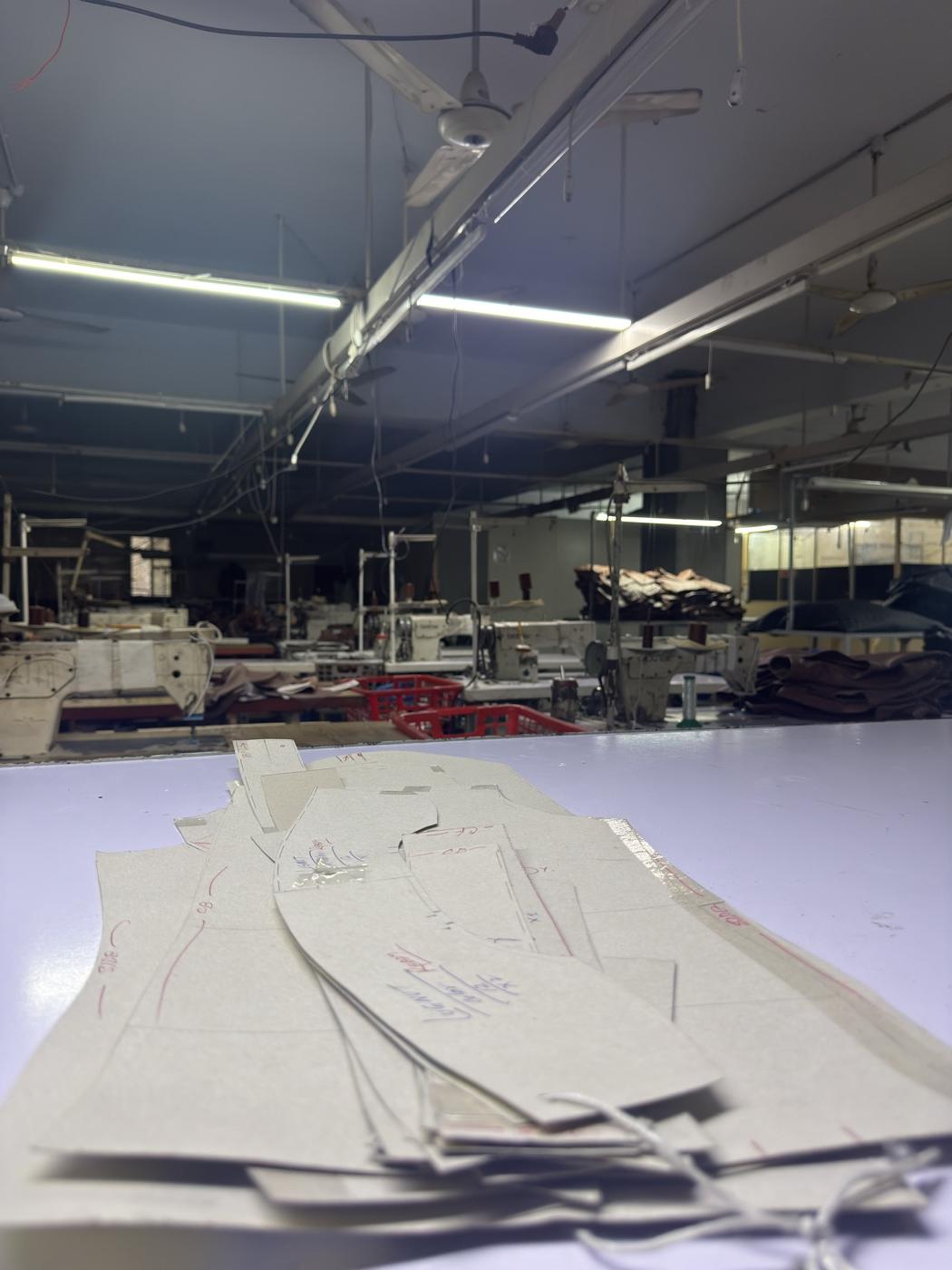
- Pattern development and grading: Creating or adjusting patterns for a new style, then grading them across a full size range (S through XXL), requires 4 to 8 hours of skilled pattern-making time. This cost is the same whether the run is 50 pieces or 500.
- Material procurement: Tanneries have their own minimums. Ordering a specific colour or finish of sheepskin may require purchasing a minimum of 30 to 50 hides. If your jacket order does not consume that quantity, the surplus becomes dead stock for the manufacturer.
- Production line setup: Configuring machines, briefing workers on a new style’s construction sequence, preparing hardware and trims, this setup takes 2 to 4 hours before the first jacket is completed. The more units the run produces, the lower the per-unit share of that setup time.
- Quality control calibration: Every new style requires QC to establish baseline standards: acceptable stitch count, correct measurements, hardware placement tolerances. This upfront work is fixed.
- Production scheduling: A factory runs most efficiently when production lines work continuously on one style for an extended period. Frequent changeovers between styles reduce throughput and increase the risk of errors during transitions.
When these fixed costs are spread across 50 units, the per-unit overhead is manageable. Spread them across 10 units and the overhead becomes a significant percentage of the total cost, either making the manufacturer unprofitable or forcing a substantial price premium.
What are typical MOQs across the industry?
MOQ varies dramatically depending on the manufacturer’s size, location, and business model:
| Manufacturer Type | Typical MOQ Per Style | Per-Unit Price Impact | Notes |
|---|---|---|---|
| Large Chinese factory | 100–300 | Lowest base price | Optimised for volume. Limited flexibility for small brands. |
| Mid-size Indian factory | 100–300 | Low to moderate | Chennai and Kanpur hubs. Variable quality between factories. |
| Turkish factory | 100–300 | Moderate to high | Higher base costs offset by proximity to EU market. |
| Italian artisan workshop | 50–200 | High | Premium positioning. “Made in Italy” commands retail premium. |
| Low-MOQ specialist | 10–25 | 30–50% premium | Viable for sampling or ultra-niche brands. Not sustainable for scaling. |
| Mac Leather (Karachi) | 30 | Competitive (no small-run premium) | Optimised production model. No inflated pricing to compensate for low MOQ. |
| Large-scale factory (any region) | 500+ | Lowest possible | Best economics at scale but inaccessible for most independent brands. |
The critical distinction is not just the MOQ number but the pricing at that MOQ. A manufacturer who offers an MOQ of 25 but charges 40% more per unit than a 50-MOQ manufacturer is not actually more flexible. They are more expensive.
How does order volume affect per-unit cost?
The relationship between volume and pricing follows a predictable curve. As order size increases, fixed costs are amortised across more units, material procurement becomes more efficient, and production line changeovers happen less frequently. Here is a realistic illustration using a standard sheepskin bomber jacket:
| Order Size | Approximate Unit Cost | Premium vs 500-Unit Price |
|---|---|---|
| 25 units | $95–$110 | +35% to +40% |
| 50 units | $75–$90 | +10% to +15% |
| 100 units | $70–$82 | +5% to +8% |
| 200 units | $67–$78 | +2% to +5% |
| 500 units | $65–$75 | Baseline |
| 1,000+ units | $60–$70 | −5% to −8% |
The sharpest drop occurs between 25 and 100 units, where fixed-cost amortisation has the greatest effect. Above 200 units, the curve flattens significantly. This is why an MOQ of 50 represents a strong balance point: you avoid the steep premium of very small runs while not requiring the capital commitment of a 200 or 300-unit minimum.
Orders under 500 units generally carry a 15% to 40% premium compared to large-volume bulk pricing, depending on the manufacturer and the specific style. This is not a markup in the punitive sense. It reflects the genuine economic reality of smaller production runs.
How does MOQ apply, per style, per colour, or per order?
This is a point of confusion that costs buyers money. There are three common MOQ structures:
- Per style per colour: This is our model and the most common. An MOQ of 50 means 50 units of Style A in black, and separately 50 units of Style A in brown. Two colours of one style = 100 total units. This is the clearest and most predictable structure.
- Per style (colour-flexible): Some manufacturers allow you to split one style across colours within the MOQ. So 50 pieces of Style A could be 30 black and 20 brown. This is more flexible but less common because it complicates material procurement.
- Per order (total): A minimum total order regardless of style or colour. For example, a minimum of 200 units across any combination of styles. This sounds flexible but can lead to shallow inventory: 200 units across four styles in three colours each means roughly 17 units per SKU, which is thin.
Always clarify the MOQ structure before requesting a quote. The number alone is meaningless without knowing what it applies to.
Size split within MOQ
Within a 50-piece order for one style in one colour, you distribute across sizes. A typical split for the European and North American market:
- XS: 2 units (4%)
- S: 5 units (10%)
- M: 15 units (30%)
- L: 15 units (30%)
- XL: 10 units (20%)
- XXL: 3 units (6%)
Adjust based on your market data. If you sell primarily in Asia, shift the curve toward smaller sizes. If your brand targets a plus-size demographic, allocate more to XL and above. We help first-time buyers determine their size ratios based on destination market.
What strategies help you work within MOQ constraints?
If your ideal first order is smaller than a manufacturer’s MOQ, or if you want to maximise the variety within a given budget, here are proven strategies:
1. Start with one hero style
Rather than spreading a small budget across three or four styles, concentrate on one jacket that defines your brand. Produce it in two colours at 50 pieces each (100 total). This gives you a focused product to market, sufficient inventory depth for sales, and a proof of concept before expanding.
2. Use existing patterns instead of full custom
Developing a jacket from scratch requires pattern creation, prototype iterations, and grading, all of which add time and cost. Starting from a manufacturer’s existing base pattern and customising the details (leather choice, colour, hardware finish, lining, labels) significantly reduces setup costs. We maintain base patterns for every major jacket silhouette and offer them as starting points for private label clients.
3. Share styles across colours strategically
If your MOQ is 50 per style per colour, produce your primary style in black (your guaranteed seller) and test a second colour only if you are confident in the demand. Do not spread 50 units across five colours. Ten jackets per colour per size gives you almost no inventory depth and makes reordering complicated.
4. Negotiate on the basis of a long-term relationship
If your first order is at the minimum, communicate your growth plans honestly. A manufacturer who believes you will order 200 units next quarter is more likely to accommodate a 50-unit first run at favourable pricing than one who thinks this is a one-off.
5. Choose standard colours and finishes
Black and dark brown sheepskin are always in stock at tanneries. Custom colours (burgundy, forest green, unusual blues) may trigger tannery minimums of 50 to 100 hides, which pushes up your effective minimum or adds lead time. For a first order, stock colours keep things efficient.
What are the common MOQ mistakes to avoid?
- Over-ordering to meet MOQ: If a manufacturer’s minimum is 300 and you can realistically sell 100 in a season, you are sitting on 200 units of dead stock. Find a manufacturer with a lower MOQ such as Mac Leatherrather than buying inventory you cannot move.
- Ignoring MOQ in your business plan: Always calculate total capital required as MOQ x unit cost x number of styles x number of colours. A “low MOQ of 50” across four styles in three colours each is 600 units and potentially $45,000 to $54,000 in production cost. Budget before you enquire.
- Confusing MOQ with total order: If a manufacturer says “MOQ 50 per style per colour” and you order one style in four colours, your total order is 200. Some buyers hear “MOQ 50” and assume 50 total across everything.
- Choosing a manufacturer solely on MOQ: The lowest MOQ is worthless if the quality is poor, communication is unreliable, or lead times are unpredictable. MOQ is one factor among 10. Read our guide on finding a reliable leather jacket manufacturer for the complete picture.
How does MOQ evolve as your brand grows?
Startup phase (first 1–3 orders)
MOQ is your primary constraint. You need a manufacturer who can work at 50 to 100 pieces per style while maintaining quality and competitive pricing. This is the phase where a low-MOQ manufacturer provides the most value, allowing you to test designs, validate market demand, and build your initial customer base without overcommitting capital.
Growth phase (orders 4–10)
You have validated your designs and know what sells. Order sizes naturally increase to 100 to 300 pieces per style. At this volume, you begin to access better per-unit pricing and faster production scheduling. MOQ stops being a constraint and becomes a baseline you comfortably exceed.
Established phase
At 500 or more units per style, MOQ is irrelevant. Your focus shifts to production capacity, lead time consistency, and the manufacturer’s ability to scale without compromising quality. Many of our clients followed exactly this trajectory: starting at 50 pieces and scaling to 500 or more per style per season within 18 to 24 months.
Why we set our MOQ at 50 pieces
Our MOQ of 50 pieces per style per colour is a deliberate business decision, not a limitation. We achieve it through:
- Batch scheduling: We group small orders from multiple clients into continuous production runs, maintaining line efficiency even when individual orders are modest.
- Tannery partnerships: Over 25 years, we have built relationships with Karachi-based tanneries that give us access to a wide range of leather types, colours, and finishes without requiring us to meet high material minimums.
- Versatile workforce: Our craftsmen are experienced across every major jacket style. Switching between styles requires minimal retraining, which reduces changeover time and cost.
- Vertical integration: We handle everything from pattern making to finished garment in-house, controlling costs at every stage without paying margins to subcontractors.
The result is an MOQ that lets startup brands enter the market with manageable capital commitment, while our pricing remains competitive against manufacturers with much higher minimums.
Ready to discuss your first order? Send us your design concept or tech pack and we will provide a detailed quote within 48 hours, including unit pricing, size ratio recommendations, and lead time. Email info@macleatherco.com or call +44 7733 077 341 (UK) / +92 332 2121 282 (Pakistan).